
A big thank you to everyone who joined us at the February 2025 PRIME Network meeting. For anyone who could not make it, or might want a refresher, please see below for a summary of what was discussed.
Highlights from this meeting
1. Active recordkeeping management
The Public Records Act 2023 (PR Act) commenced on 5 December 2024 but many of the obligations for public authorities remain unchanged. To meet your public authority’s continuing obligations, your public authority needs to actively manage its public records.
If your public authority does not have systems in place to enable you to know what records you have, where they are and for how long you need to keep them, it will be hard to meet your statutory obligations.If you are looking for advice for active recordkeeping management and the implementation of the Records governance policy, there is existing guidance on our website which may be of assistance, including:
• implementation guideline
• recordkeeping maturity assessment tool
• risk and disaster management for records.
Section 21 of the PR Act
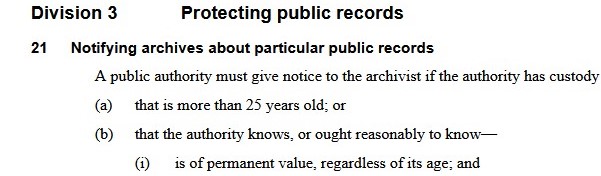
Section 21(a) is an existing obligation (previously s.10 of the repealed Public Records Act 2002). Section 21(b) is a new requirement, where public authorities must notify the State Archivist if the authority knows, or ought reasonably to know, that it has permanent value public records in their custody which are at risk of loss or damage. This includes records stored with other entities.
The focus of s21(b) is on proactive management of permanent value records to avoid loss or damage. It is not a new requirement to manage permanent public records and keep them safe from loss or damage, the only new part is that public authorities must notify the State Archivist if they know that they have permanent public records in their custody at risk of loss or damage. QSA is in the process of developing a form that public authorities can use to notify the State Archivist. In the meantime, if you have any permanent value public records at risk of loss or damage, please notify us at discovery@archives.qld.gov.au as soon as possible.
Managing risks to physical records

Some of the key threats to physical public records are referred to as the “Agents of Deterioration”, namely: water, fire, storage, mould, contamination, physical or structural collapse, malicious acts, pests and light.
The records storage criteria assessment tool is intended for public authorities to guide authorities through various aspects of storage. It is based on the National Archives of Australia (NAA) Storage Standard but uses a traffic-light scoring system and a report so that you can evaluate areas of strength and where improvements might be needed.
Risks to records in a digital landscape
Digital records depend upon software, hardware and media that constantly change. Technological obsolescence and poor records management practices across the lifecycle of digital information place digital records at risk of losing their integrity and authenticity, or simply becoming lost or inaccessible.
To ensure the longevity and accessibility of digital records, public authorities should implement proactive strategies, such as regular system audits, robust migration planning, and incorporate best practices from digital preservation in their current records management processes. It is important to note that these tasks need to happen sooner and more often as time and benign neglect can silently render critical records obsolete, costly to maintain, or completely lost. Unlike physical records, when a digital record is corrupted or damaged, it may already be too late.
Lost or damaged records

Submitting an application to dispose of damaged records does not guarantee that approval will be granted. As such, you should do what you can to mitigate further damage to the records, in case you are asked to take further remediation action.
To approve disposal or accept a notification, the State Archivist will need sufficient information to prove that the records are permanently lost or irreparably damaged and all effort has been taken to restore the records and mitigate further risk. You also need to take action to prevent this loss or damage from re-occurring.
Please reach out to QSA at rkqueries@archives.qld.gov.au as soon as you identify lost or damaged records. We are here to help and provide guidance and support!
Delegations of authority for public access
Under the PR Act, chief executives are responsible for making decisions about access to their public authority’s records in QSA’s collection. However, they may choose to delegate this authority to an appropriately qualified position or individual.
The two delegations relating to records access are:
• providing a Restricted Access Notice (RAN) under sections 28-32 of the PR Act; and
• determining applications to access restricted records under section 38 of the PR Act.
While nominating delegates is not mandatory, it is important to note that if your chief executive does not choose to delegate their authority, all public records access matters will require their authorisation.
All public authority delegations for records access made under the previous Public Records Act 2002 expired on 5 December 2024 when the new PR Act commenced and need to be re-authorised by your chief executive. Until new delegations are received, your chief executive remains solely responsible for providing Restricted Access Notices and making determinations on restricted access applications.
To authorise new delegations, use the updated delegation form.
Mandatory records management standard consultation update

QSA commenced consultation on the approach to mandatory standards and draft mandatory standard one in November and early December 2024. Key findings from this consultation included:
- Stakeholders want standards to:
• help others understand recordkeeping requirements
• provide clear requirements
• deal with records across systems
• garner support from senior leaders - Stakeholders evenly supported the approach used by:
• Public Records Office of Victoria (PROV) based on principles with requirements which are concise, simple and high level – provides flexibility and less clarity
• State Records NSW based on principles which clearly identify specific minimum compliance requirements – provides clarity and less flexibility - Although supported, there was some confusion about what an outcomes-based approach to mandatory standards is, noting this was QSA’s first round of consultation about this approach. For instance, there was some concern the approach may be too flexible and not provide clarity about minimum requirements
- Strong need for standards to deal with minimum metadata requirements
- Explore including:
• mandatory records management training within public authorities
• assigning roles and responsibilities including senior leadership
• a standard on operational management (like PROV) and/or functional requirements
The next round of consultation on draft mandatory records management standards and supporting guidelines will commence on 22 April and close on 16 May 2025.
Details will be provided on our News and events page as they become available.
More Information
We would like to thank everyone who attended the February PRIME meeting, and we look forward to seeing you at the next PRIME meeting on Wednesday 14 May 2025! Keep an eye on our News and events page more information about this event.
 Records Connect
Leave a Reply