
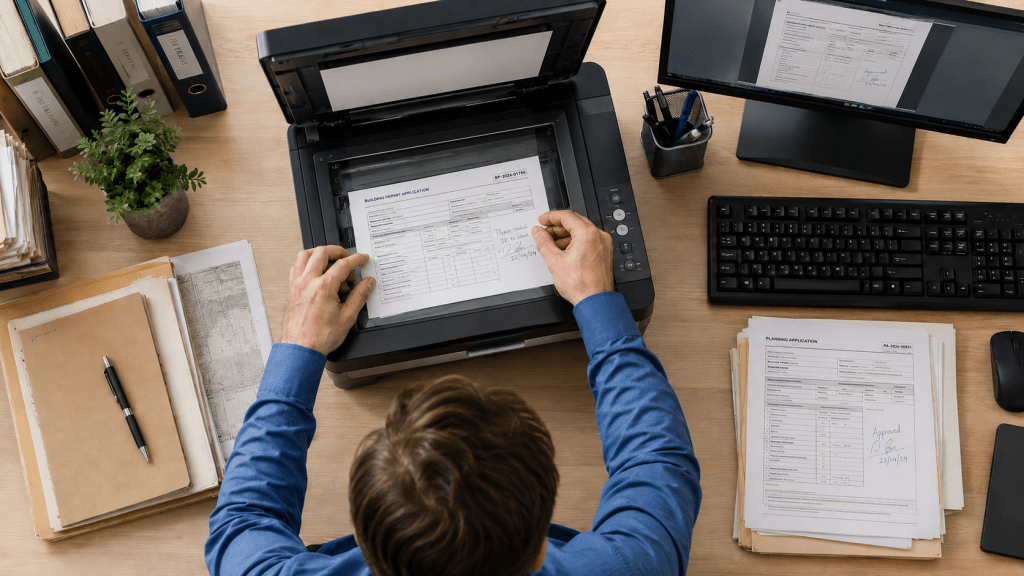
Public authorities can now digitise and dispose of some permanent physical records, where the required conditions are met in accordance with the Source Records retention and disposal schedule. This means your public authority may be able to scan permanent value records, keep the digitised copy as the official record and dispose of the physical source record.
In this blog, we’ll look at what quality is required, how to reduce risks during digitisation and some common misunderstandings.
Before you start scanning
Before starting, it’s important to understand which records are eligible for scanning and disposal, and what requirements apply. Under the Source Records retention and disposal schedule, certain public records can be destroyed after digitisation, provided they have either:
- a temporary retention status under a current disposal authorisation
or,
- a permanent retention status under a current disposal authorisation, and were created on or after 1 January 1980
Disposal of any source record is only permitted when all disposal conditions outlined in DA 2940 Temporary source records and DA 2941 Permanent source records created on or after 1 January 1980 have been met. One of these conditions is that a digitised or converted record must be an accurate, legible and authentic reproduction in its entirety.
What this looks like in practice may differ between temporary and permanent value public records. For temporary value records, your public authority should decide the digitisation quality needed to support its business needs. Where temporary records need to be kept for a medium to long-term period, they should be digitised and maintained at a quality that keeps them legible, authentic and accessible for their full retention period.
For permanent value records created on or after 1 January 1980, more rigorous technical specifications and quality assurance are required to ensure that their evidentiary value or legal standing remains intact when converting the original to a new format. This includes detailed documentation during digitisation and disposal.
Records created before 1 January 1980 may have significant historical, cultural or intrinsic value because of their age, format or unique characteristics. These records require special consideration and are generally not eligible for disposal after digitisation. If your public authority wants to digitise permanent records created before 1 January 1980 and dispose of the source records, contact QSA for advice.
Fragile records may also need specialist equipment, handling or techniques to protect the source record and ensure a complete and accurate reproduction. If digitisation may damage or further degrade a fragile public record, contact QSA.
Source records must be retained where:
- records have already been transferred to the Queensland State Archives collection and are on loan to the public authority
- records are subject to a protection notice or other legislative obligations requiring the retention of the source record
- records are unable to be accurately reproduced because of unique properties, evidence or information in the original format
- records are considered to have intrinsic value in their original format, which would be lost if the records were converted to another format
- records are, in their original format, significant to the identity of First Nations peoples and communities.
Once you have confirmed the records are eligible for digitisation and disposal, the next question is whether the digitised version is sufficient to replace the source record.
What does an appropriately digitised record look like?
Instead of prescribing what equipment or specifications your public authority must use, QSA has developed an outcomes-based approach. This allows your public authority to choose hardware, software and settings that are practical for your business processes, as long as the digitised record is an authentic and accurate copy of the original public record.
An appropriately digitised record should be legible, uncropped, and correctly aligned. It should contain all information that is present in the source record, including (but not limited to) annotations, attachments, enclosures, colour, and page numbering. When digitising records, it’s also important to ensure all metadata needed to identify, manage and preserve the record is captured as part of the process. Any optimisation required during scanning should only improve legibility or the quality of faded or indistinct elements, not change the appearance or meaning of the source record.

Using minimum recommended specifications to reduce risk
QSA has developed minimum recommended technical specifications to help public authorities reduce the risk of losing information during digitisation. These specifications provide a baseline for creating digitised records that are accurate, complete and fit for purpose.
Where possible, we recommend scanning at the highest quality available on your equipment. Higher quality capture can reduce the risk of losing information that may not be obvious at first, such as faded handwriting, annotations, stamps, shading, watermarks or details in photographs.
We also recommend capturing colour for all digitisation projects, including standard printed documents. This ensures tonal and contextual information present in the original source record is preserved.
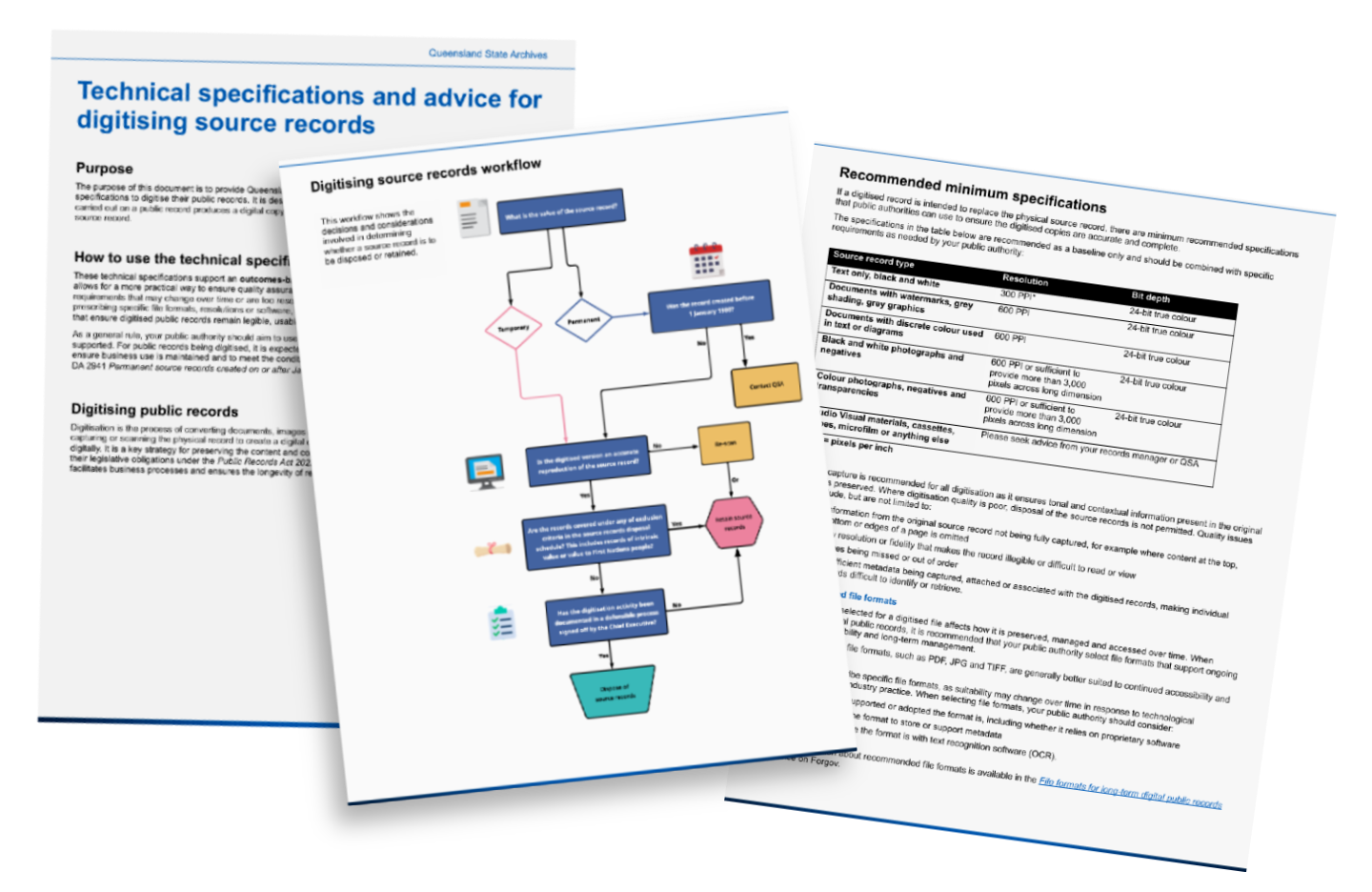
Our technical guidance for digitisation has a list of recommended minimum specifications, digitisation workflow and more detailed advice on the required outcomes for digitising public records.
Checking the quality and documenting the process
Before disposing of any source records, make sure your digitised records are accurate, complete and legible. This means having quality assurance checks and a defensible process in place to confirm that the right records have been digitised, the digitised copies are fit for purpose, and disposal is authorised under an applicable disposal authorisation.
Quality assurance checks help identify issues such as missing pages, cropped edges, incorrect page order, poor image quality, faint handwriting, missing attachments or insufficient metadata. These checks should be part of your digitisation workflow. If quality assurance checks identify problems that cannot be corrected through re-scanning or other remedial action, the source record must be retained.
Where digitisation is outsourced, your public authority should include quality assurance requirements in contracts or service level agreements. Outsourcing the work does not transfer responsibility for the public records. Your public authority remains responsible for ensuring the quality of digitised public records and for authorising any disposal of source records.
It is also important to document the decisions and approvals that support your digitisation work. Not all digitisation activities will require the same level of documentation, but you should consider documenting:
- what records were digitised and why, including record type, date range and business function
- whether the records were assessed for archival, enduring or intrinsic value
- the digitisation method used, including resolution, file format and colour settings
- confirmation that quality assurance checks were completed and verified
- where and how the digitised records will be stored and managed
- any contracts, agreements or statements of work with third-party providers
- evidence that disposal of source records has been approved by the Chief Executive or authorised delegate.
To assist your public authority in developing a defensible process, QSA has prepared a template you can adapt for your digitisation activity.
Before any disposal takes place, check that the source records are eligible for disposal, the digitised records meet the required quality standard, and the disposal decision has been appropriately authorised and documented. If the digitised record is incomplete, inaccurate or cannot be relied on, the source record must be retained.
Common misunderstandings when digitising public records
If I can read it, it’s good enough
Readability matters, but it is not the only measure of quality. A digitised record also needs to capture the information and context of the source record, including page edges, annotations, stamps, enclosures, page order, colour, tone, watermarks and other details that may affect meaning. A scan might be readable but still incomplete. The recommended minimum specifications provide a useful baseline, but where possible, use higher quality settings and avoid heavy compression that may remove detail, affect legibility or change the appearance of the source record.
JPEG is good because it saves storage
JPEG is widely supported and can help reduce file size, but heavy compression may permanently remove information from the digitised record. If compression affects legibility, removes detail or changes the appearance of the source record, the digitised copy may no longer be accurate enough to rely on. Where possible, use lossless compression to reduce file size without discarding information.
The scan is the whole record
A digitised image or PDF is only part of the record. Metadata provides important information that helps identify, manage, access and understand the digitised record over time. This may include details such as title, date, record type, creator, business context, disposal information and relationships to other records or files. Without this information, a digitised record may be harder to find, manage or understand, even if the scan itself is clear and complete.
Outsourcing is a way to transfer the risk
Outsourcing digitisation does not transfer responsibility for the records. Your public authority remains legally responsible for the records while they are in the service provider’s custody, including ensuring the provider meets all requirements in the contract or agreement.
I need to buy a new scanner to meet the requirements
You may not need to buy new equipment. QSA’s outcomes-based approach does not require a specific scanner, brand or hardware configuration. What matters is whether the equipment and settings you use can produce a complete, legible and accurate reproduction of the source record. The hardware your public authority already has access to may be suitable.


Leave a Reply